Pages

Showing posts with label light. Show all posts

Sunday, September 6, 2020

NGSS...Exploring Light and Sound Waves


Students will enjoy developing an understanding of core ideas through experimentation, reflection, and vocabulary study. Although this resource is designed to meet the 1st Grade Next Generation Science Standards it would also be appropriate for other grade levels.

PS4-1

PS4-2

PS4-3

PS4-4

Find it here.

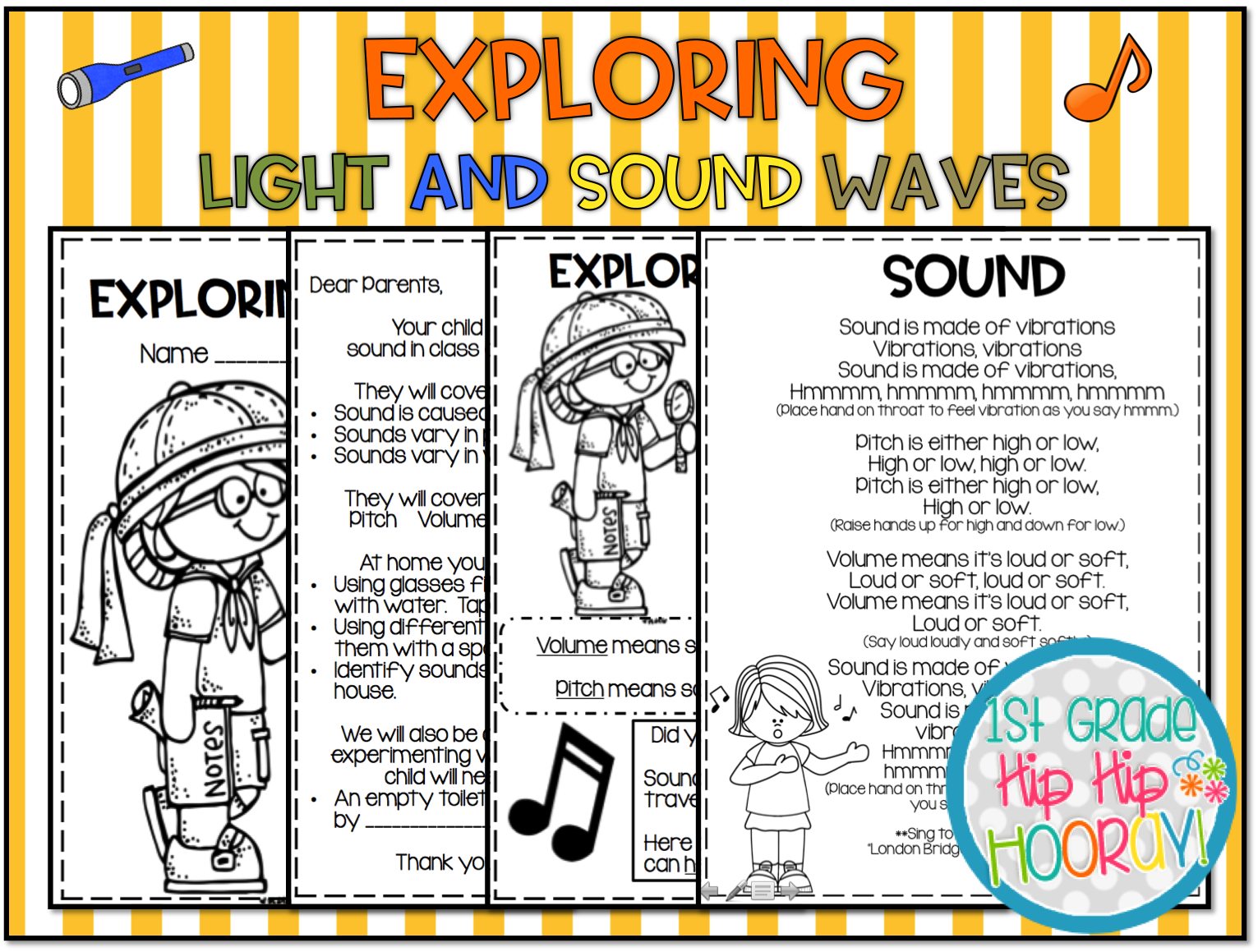
Student Activity Book Cover

Parent Letter...sharing what students will be covering and how they can help

Informational Text...Easy text explaining the topics

Vocabulary Cards for Posting

Poster with Core Ideas

Posters: Translucent, Transparent, Opaque, Illuminate, Vibrate, Pitch, Volume, Shadow, Communication

ABC Order

Word Search

Syllables

Light Sort

Light ...natural/artificial

Imagine this...experiment with darkness

Illumination activity

Illumination List

Poster...translucent/transparent/opaque

Experiment with degrees of light

Magnifying glass for adding foil, wax paper, clear 

Flashlight Predictions

Reflections

Shadows Activity

Mini Interactive Book on Shadows

Mirror Experiment

Sound Sort

Sound List

Make a Kazoo Experiment

Reflection

Good Vibrations...Rubber Band Band

Reflection

Musical Vibrations...Ruler

Reflection

Think it Through

Mini Book on Volume and Pitch

How We Communicate

Communication Hands On


Also available is this resource with Google Slides.
Again the core ideas are covered and opportunities for students to show they understand the concepts are provided.
Slide One:  Core Ideas
Slide Two:   Investigating Light/Informational Text
Slide Three:  Illuminate/Sort
Slide Four: Objects can Block Light/Informational Text
Slide Five:  Sort into Translucent, Transparent and Opaque
Slide Six:  Understanding shadows.
Slide Seven:  Exploring Sound/Informational Text
Slide Eight:  Poem about sound.
Slide Nine:  Volume/Sort
Slide Ten:  Pitch/Sort
Slide Eleven: Ways we communicate.
Perfect for distance learning or the computer center.
Slides can also be used to teach.
Find it here.


Monday, April 22, 2019

Exploring Light and Sound NGSS

Let's Explore Light and Sound Waves  NGSS
The packet is filled with activities that allow students to predict, experiment, reflect, and create.
It allows you the teacher to assess, teach and provide meaningful activities for their class so students will better understand the core ideas of this topic.
Although it is written for NGSS 1st Grade other age level students would benefit from these activities.

Throughout the packet their are posters to place in key areas so that you as well as the students are able to clearly see what "big idea" is being taught with the activity being presented.
One of my favorite books to start the unit with is Light All Around Us.
I also use a big sheet of chart paper and students brainstorm what gives us light.
As we work through the unit we continue to add to this list.
WHERE DOES LIGHT COME FROM?


Vocabulary is so important in teaching any unit.  
There are 12 vocabulary cards for posting.
By the end of the unit students should be able to share the meaning for each word.
Also found are ABC order, a word search, making words and syllable activities .
I like using these in my word work center.

I prepared a cover for students to use to collect their information in.
I use a piece of construction paper folded in half with the cover pasted on one half.
You can also put all the pieces together and form a book.
There is also a parent letter sharing with parents key concepts you will be covering and a page with Informational Text.

Students will sort natural light and artificial light using words or pictures depending on ability.
They will go on a "light" hunt with a partner around the classroom. (not shown)
Then they will work with and IMAGINE IF
Following the discussion they will reflect on what the "big idea" was.
Students will also imagine a camping trip and think about "natural and artificial" lights might be found.

Another lesson focuses on Opaque, Translucent, and Transparent.
These "big ideas" may take three days to work through using the suggested experiments.

I like the books below for teaching the lessons on shadows and on mirrors.
The students experiment and then reflect. 
Always be sure class discussion follows the explorations.


Sound waves follows a similar pattern.


Students will work with volume and pitch.
There are sorts as well as experiments followed by reflections.
The experiments focus on vibrations.
One is a kazoo and the other a cup instrument.

Students will also use a simple ruler to watch vibration and listen for sound.
There is also a book for talking about pitch and volume.

The packet ends with students designing a form of communication using light and sound or both.
It is always exciting to see what they come up with.


Monday, January 8, 2018

Shadow Exploration!

With Groundhog day shortly approaching I just love this activity using a groundhog puppet and a flashlight.

Look at this adorable groundhog puppet!!
All you need is a flashlight and partners can explore shadows.
There is also colorful vocabulary for posting!!

There are three forms of informational text to help your class develop and understanding of shadows.

Here are graphic organizers for collecting facts and a connect text to facts using the story Bear Shadow by Frank Asch.

Also are two explorations including reflection sheets.


Friday, July 7, 2017

Exploring Light and Sound Waves

Let's Explore Light and Sound Waves
The packet is filled with activities that allow students to predict, experiments, reflect, and create.
It allows you the teacher to assess, teach and provide meaningful activities for your class so they will better understand the core ideas of this topic.
Although it is written for NGSS 1st Grade other age level students would benefit from these activities.

There are 12 vocabulary cards for posting in the room.
These are followed by vocabulary building activities ideal for your word work center.

Core ideas are listed and ready for posting.
There is a home/school connection note for parents.
Covers are available so activities can be made into a booklet easier for organization.

Both sound and light begin with informational text.
You should also visit the library and pick up books for reviewing.
There are pre assessment activities in the form of a list and a sort.

Teaching is done through making predictions, testing our thoughts and then reflecting.
The first study is about illumination.
There is also an activity using mirrors and reflections.

This is followed by looking a opaque, transparent and translucent.
There are explorations, reflections and a post assessment.

Next students look at shadows.
A student observation and recording book is available for looking at shadows and the position of the sun.

Again sound begins with Informational text and pre assessments.


There are two experiments to study vibrations.
One is making a kazoo and the other is creating a rubber band guitar.
After creating and experimenting students reflect.

There is a final experiment on vibration and pitch with a reflection and a prediction.


As an end to the unit of study the students use what they learned to create a form of communication.